The IQPC Trust and Safety Summit felt less like a conference and more like a gathering of people aligned around a shared mission. There was a clear sense that everyone in the room was working toward the same goal: making digital spaces safer, despite the often invisible toll this work takes.
Discussions on AI governance and content moderation carried a strong sense of camaraderie. Conversations didn’t stop at the sessions. Hallway chats turned into deep dives on shared challenges. There were nods of recognition across talks, and a consistent feeling of “we’re all in this together.”
Across the board, one theme remained constant: user safety. Leaders spoke about how to build, scale, and embed it into systems from the ground up.
Safety by design
The phrase “safety by design” came up repeatedly throughout the summit. It reflected a clear shift from reactive solutions to proactive system design.
Speakers across organizations, from hyperscalers to decentralized platforms, described how safety is now being embedded directly into products, policies, and AI pipelines. The goal is to reduce exposure to harm before it happens, whether that is relational abuse, child exploitation, or emerging risks.
This thinking extends beyond user safety. The same principle applies to how organizations approach wellbeing.
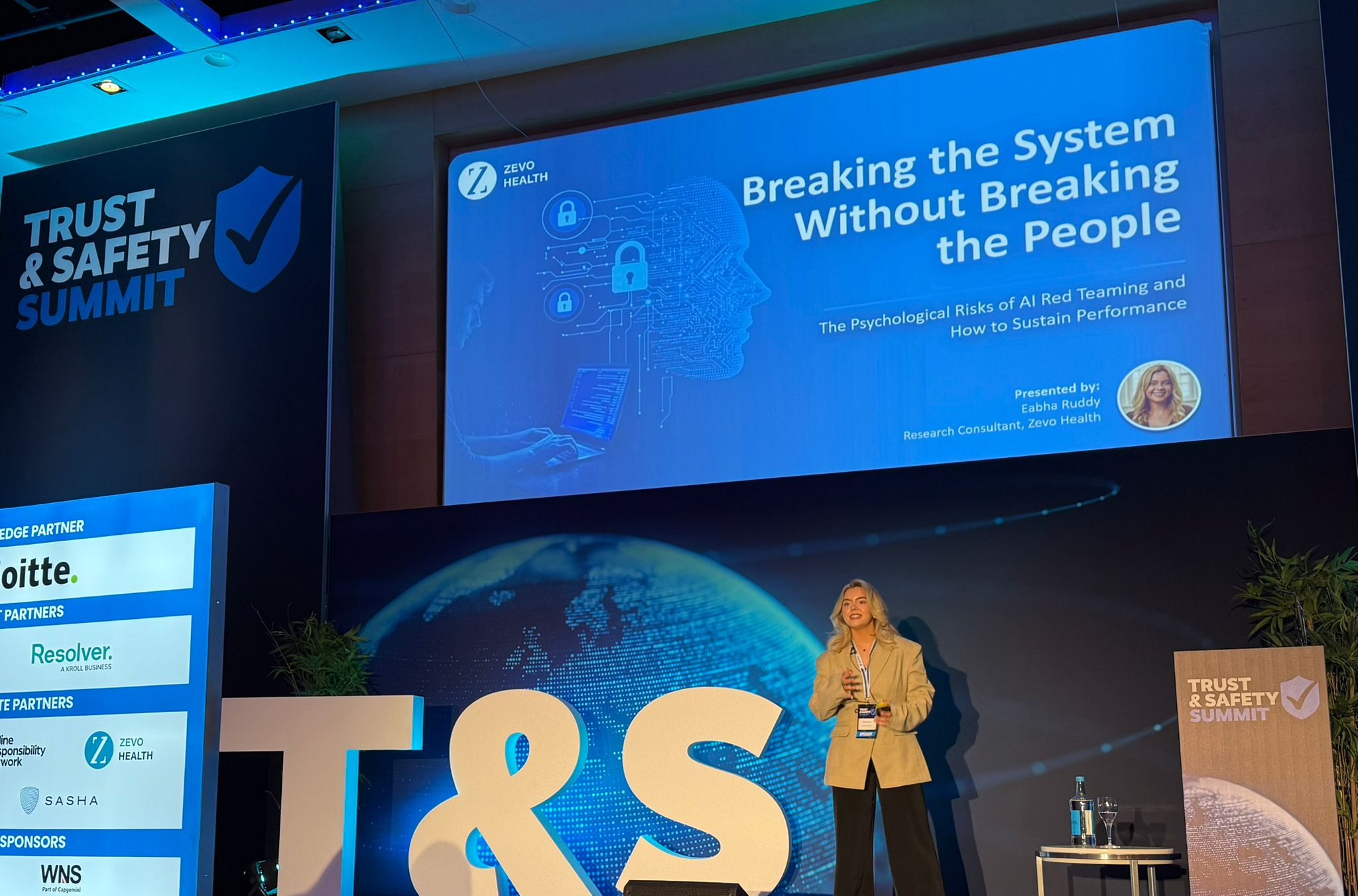
In my talk, Breaking the systems without breaking the people, I explored the psychological risks associated with AI red teaming and how performance can be sustained by embedding wellbeing into work design.
In this context, safety by design means introducing early interventions that mitigate risks such as moral injury, creative fatigue, and burnout. It also means recognizing that exposure to high-risk content or adversarial thinking requires structured recovery, not just resilience.
For example, onboarding often focuses on technical capability, such as threat detection. But it should also include recovery practices, such as structured breaks and de-roling exercises after extended periods of adversarial work.
Just as user safety prevents downstream issues, embedding wellbeing into workflows helps sustain performance, particularly in environments that demand prolonged cognitive and emotional effort.
Panels that got me thinking
Two sessions in particular stood out.
The safety stack: how tech leaders are embedding child protection into AI introduced the idea of layered protection systems.
This concept closely mirrors how wellbeing should be structured. Rather than relying on a single intervention, effective support comes from multiple layers working together. In my session, I referred to this as a wellbeing operating model, where different supports combine to protect both performance and capacity.
Trust and safety over time: experience and evolution highlighted the pace at which the industry continues to change.
As content moderation becomes more complex, the expectations placed on professionals continue to grow. Teams are constantly adapting to new risks, new policies, and new technologies.
This ongoing evolution has a direct impact on wellbeing. Without the right support, the cumulative pressure of continuous change can become a significant risk in itself.
For wellbeing providers, this reinforces the need to stay aligned with how the industry is evolving, ensuring that support models adapt alongside operational demands.
Forward momentum from shared belonging
One of the strongest takeaways from the summit was the sense of shared responsibility and belonging.
The trust and safety space is built on people who care deeply about protecting others. That sense of purpose is a strength, but it also requires support to be sustained over time.
Safety by design should not only apply to platforms. It should also apply to the systems that support the people behind them.
When wellbeing is embedded into how work is designed, it enables professionals to continue performing effectively without compromising their mental health.
At Zevo Health, these principles are central to how we approach trust and safety. The goal is to build systems that allow teams to operate at a high level without absorbing unnecessary psychological risk.
The summit served as a strong reminder of how committed this community is to protecting users, and the importance of ensuring that the same level of care is extended to the people doing the work.
Whitepaper | Why Red Teaming Requires Tailored Wellbeing Solutions
Explore why the psychological and ethical demands of red teaming require wellbeing approaches distinct from traditional content moderation, supporting resilience in high-pressure roles.